
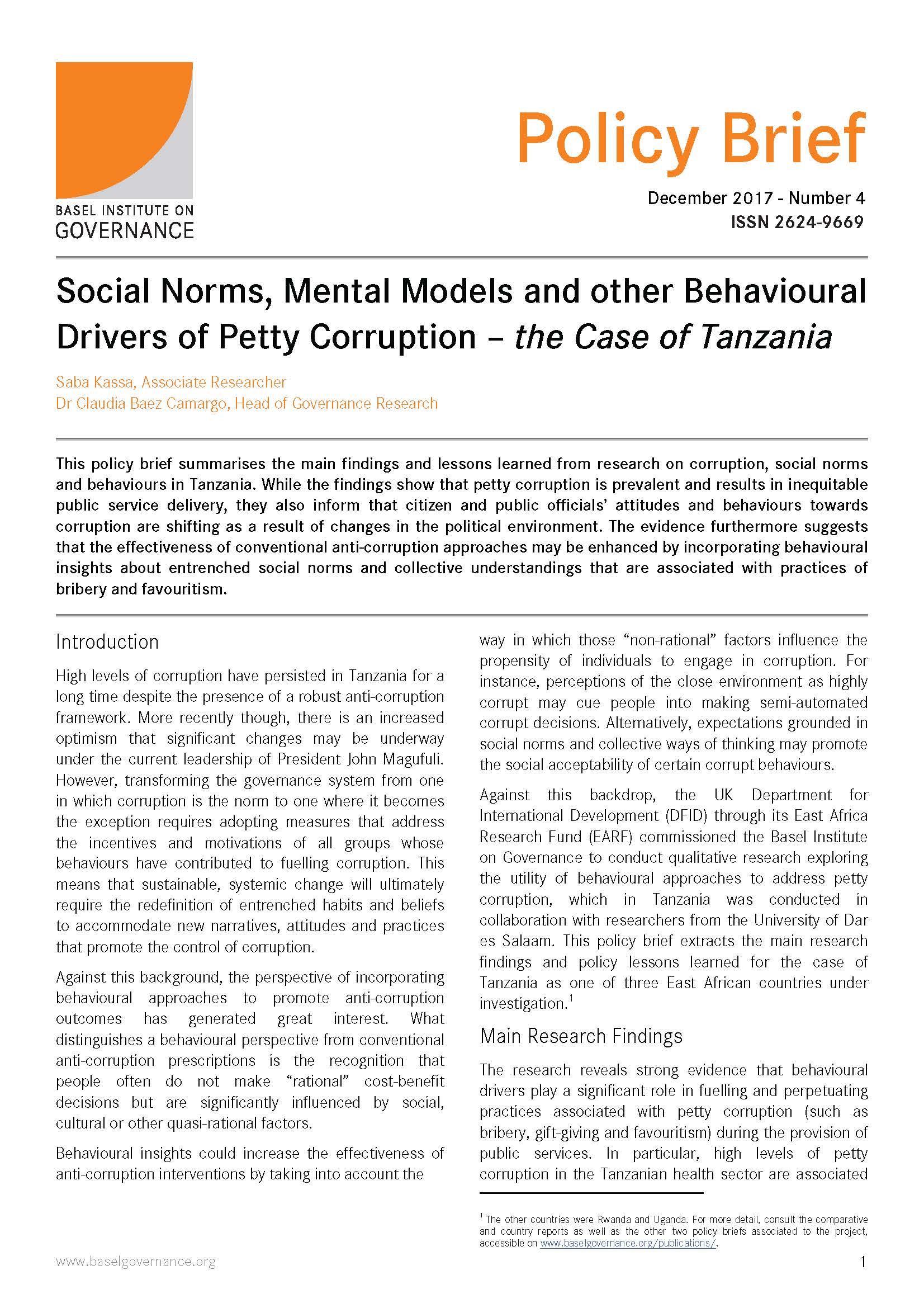
Policy Brief 4: Social norms, mental models and other behavioural drivers of petty corruption
The case of Tanzania
Keywords:
social norms, social networks, corruption research, anti-corruption strategies, anti-corruption interventions, behavioural researchAbstract
This policy brief summarises the main findings and lessons learned from research on corruption, social norms and behaviours in Tanzania. While the findings show that petty corruption is prevalent and results in inequitable public service delivery, they also inform that citizen and public officials’ attitudes and behaviours towards corruption are shifting as a result of changes in the political environment.
The evidence furthermore suggests that the effectiveness of conventional anti-corruption approaches may be enhanced by incorporating behavioural insights about entrenched social norms and collective understandings that are associated with practices of bribery and favouritism.
Downloads
Published
How to Cite
Issue
Section
License
Copyright (c) 2017 Basel Institute on Governance

This work is licensed under a Creative Commons Attribution-NoDerivatives 4.0 International License.